
- Over the past few decades, neuroscience has made huge leaps in understanding the brain and all its complexities.
- One of the new leading techniques in training the brain is called neurofeedback.
- The technique is used to treat a variety of mental health issues and is also used by high-performing individuals to enhance their brain function.
Over the past few decades, neuroscience has made huge leaps in understanding the brain and all its complexities. Most notably, the concept of neuroplasticity. At any given moment in our lives, we have the power to change our brains. Now that we know we can, the challenge becomes how we do it. One of the new leading techniques in training the brain is called neurofeedback. The technique is used to treat a variety of mental health issues and is also used by high-performing individuals to enhance their brain function. We sat down with our neurofeedback expert, Eva Larragay, to discuss how it works, the science behind it, and who stands to benefit.
Neurofeedback, also known as EEG biofeedback, is a type of biofeedback that uses real-time monitoring of brain activity to teach people how to self-regulate their brain function. A recording of the electrical activity in the brain is taken using an electroencephalography (EEG), and the practitioner provides feedback to the individual through visual, auditory, or tactile signals. This feedback helps individuals learn how to modulate their brain waves, aiming to optimise its function.
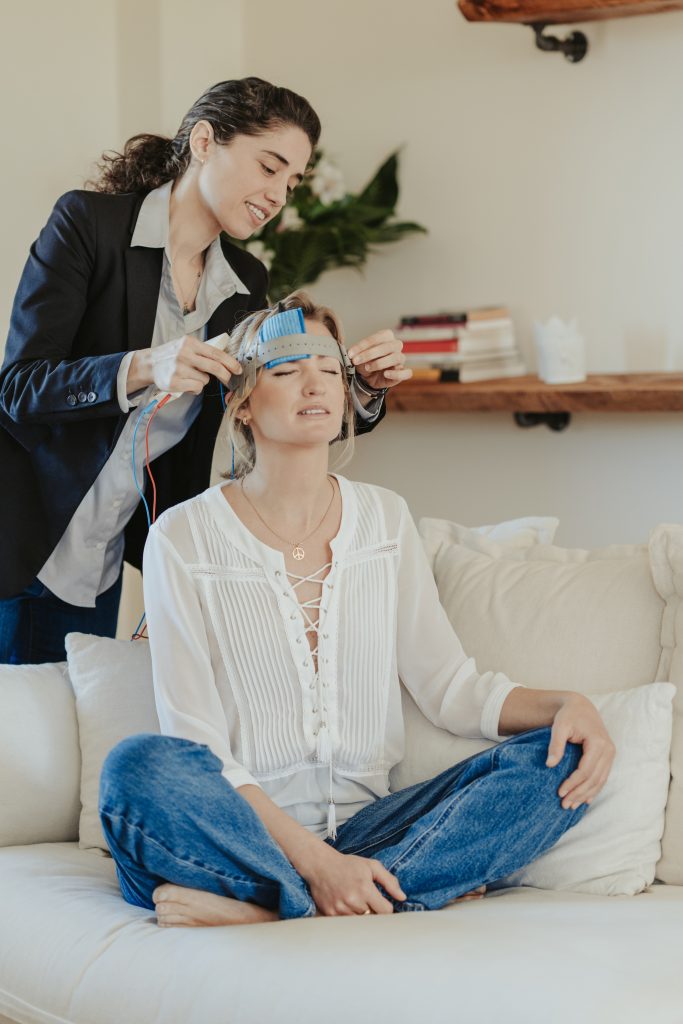
“It’s the gym for your brain,” says expert Eva Larragay. “Neurofeedback is a non-invasive, and painless technique that trains the brain to work in the way we want it to work.” A process begins with an initial assessment of brain activity. A practitioner places a set of electrodes on a patient’s scalp to get information fed back into the EEG scan. Based on the assessment, specific goals are set. The feedback mechanism (auditory, visual or tactile) responds in real-time to the brain’s activity, rewarding specific brainwave patterns and discouraging other ones. We can train the brain to turn on or turn off. We can train specific brain patterns like Alpha waves, which are associated with deep relaxation, creativity and focus. It is important to note that this technique does not require the patient to speak in any way. When dealing with mental struggles, often times the last thing a person wants to do is speak about it. Neurofeedback is one of the ways we can heal silently. Over multiple sessions, the brain can learn to produce desired brainwaves more consistently, leading to improved self-regulation.
Neurofeedback leverages the brain’s neuroplasticity, or its ability to reorganise itself by forming new neural connections. By repeatedly providing feedback on brain activity, neurofeedback helps to ‘rewire’ the brain, promoting healthier brainwave patterns. Through long term study of EEGs, we know the patterns associated with different states of activity and cognitive functions:
- Delta waves (0.5-4 Hz): Associated with deep sleep, transcendence, and restoration.
- Theta waves (4-8 Hz): Linked to visualisation, trance, or dreaming
- Alpha waves (8-12 Hz): Related to meditation, creativity, and relaxation.
- Beta waves (12-30 Hz): Associated with alertness, concentration, and thinking.
- Gamma waves (30-100 Hz): Linked to peak experiences, insight, and synchronisation.
Neurofeedback training aims to balance these brainwave frequencies, enhancing overall brain function and reducing symptoms of various mental health conditions.
Neurofeedback can help anyone that is willing to do it! But there are specific populations that it has shown significant promise with in treatment, including:
- Attention Deficit Hyperactivity Disorder (ADHD): Research indicates that neurofeedback can reduce symptoms of inattention, hyperactivity, and impulsivity in children and adults with ADHD.
- Anxiety and Stress: Neurofeedback helps in training the brain to produce more alpha waves associated with relaxation, thus reducing anxiety and stress levels.
- Depression: By promoting more balanced brainwave activity, neurofeedback can alleviate symptoms of depression.
- Post-Traumatic Stress Disorder (PTSD): Neurofeedback has been used to help individuals with PTSD by promoting stability and reducing hyperarousal.
- Sleep Disorders: Training the brain to produce the appropriate brainwave patterns can improve sleep quality and reduce insomnia.
- Traumatic Brain Injury (TBI): Neurofeedback can aid in recovery from TBI by enhancing cognitive function and reducing symptoms like brain fog and fatigue.
- Autism Spectrum Disorder (ASD): Neurofeedback may improve attention, behavior, and emotional regulation in individuals with ASD.
- Peak Performance: Athletes, musicians, and high-performing individuals like CEOs can use neurofeedback to enhance focus, creativity, and performance by optimising brain function.
Neurofeedback is a non-invasive, painless technique that allows us to train brain patterns to achieve optimal results. A picture of the brain’s electric activity is fed through a series of electrodes placed on a patient’s scalp and sent back to an EEG. A practitioner can read the brain patterns and provide feedback to the individual through visual, auditory, or tactile signals to train certain brain patterns. It’s “the gym but for your brain,” says our expert. While research remains ongoing, neurofeedback has shown significant promise in certain populations like those with ADHD, depression and anxiety, and high-performing athletes. Though it stands to benefit anyway looking to train their brain. As the field continues to grow, it holds the potential to unlock new levels of human potential.
The Article
About This Article
✔ Medically Reviewed
✔ Evidence-Based Sources
✔ Updated Regularly
✔ Clinically Verified
This article was written by THE BALANCE’s clinical content team and reviewed by a licensed medical or mental health professional (such as an MD, psychiatrist, clinical psychologist, or equivalent). Our reviewers ensure that the information reflects current research, accepted medical guidelines, and best practices in mental health and addiction treatment. THE BALANCE’s medical editors draw on extensive real-world clinical experience supporting individuals in residential, outpatient, and luxury private treatment settings across Europe and internationally.
Editorial Standards & Integrity
THE BALANCE follows strict editorial and clinical review standards to ensure accuracy, balance, and reliability:
- All medical statements rely on authoritative sources such as the WHO, NIMH, APA, NHS, CDC, and SAMHSA
- Statistics use the most recent and reliable research available
- No medical or therapeutic claims are made without clear, verifiable evidence
- Content is reviewed and updated regularly to reflect evolving science, treatment guidelines, and clinical best practices
- Commercial interests do not influence clinical accuracy; all clinical insights are reviewed independently
- Recommendations include context, limitations, and alternatives where appropriate
How We Review Sources
- Our clinical writers and editors rely on:
- Peer-reviewed research and meta-analyses
- National and international treatment guidelines
- Professional bodies and regulatory authorities
- Verified public data from reputable institutions
We do not use anecdotal reports, unverified claims, or commercially biased sources. Every factual claim is supported by established evidence.
Conflicts of Interest
THE BALANCE provides private mental health and addiction treatment services. However, our clinical reviewers ensure that all content remains objective, non-promotional, and balanced. When discussing treatment options, we outline limitations, risks, and alternatives. Our priority is reader safety and informed decision-making.
How to Use This Information Safely
Mental health and addiction conditions are complex and vary significantly between individuals. The information in this article is provided for general educational purposes only and should not replace professional medical advice, diagnosis, or treatment. If you or someone you know is experiencing symptoms, seek guidance from a qualified healthcare professional. To maintain accuracy and trust, THE BALANCE updates articles regularly as new research and clinical guidance become available.
Do you need help?
If you’re struggling, you don’t have to handle it alone. Support is available - whether you’re feeling overwhelmed, anxious, depressed, or dealing with alcohol or drug-related concerns. If you feel unsafe, are at risk of harming yourself, or someone else is in immediate danger, contact your local emergency number immediately.
Talk to Someone Now (Free & Confidential)
Choose your country to find a trusted helpline near you:
Spain
- Suicide & emotional crisis helpline: 024 (24/7, free, multilingual)
- Samaritans in Spain: 900 525 100 (24/7)
Switzerland
- Die Dargebotene Hand / La Main Tendue: 143 (24/7)
- Pro Juventute (youth): 147
United Kingdom
- Samaritans: 116 123 (24/7, free)
- NHS urgent mental health support: call 111 (24/7)
United States
- 988 Suicide & Crisis Lifeline — call, text, or chat 988 (24/7)
Canada
- 9-8-8 Suicide Crisis Helpline — call or text 988 (24/7, nationwide)
- Talk Suicide Canada (alternate): 1-833-456-4566
France
- National suicide prevention number: 3114 (24/7, free)
Germany
- TelefonSeelsorge: 116 123
- Alternate numbers: 0800 111 0 111 / 0800 111 0 222
Italy
- Telefono Amico Italia: 800 860 022 or 02 2327 2327
Not an Emergency, but You Want Support?
If you’re not in immediate danger but are worried about yourself or someone you care about, reaching out early can make a meaningful difference.
Explore Care Options Near You
This website lists verified mental health professionals, addiction specialists, and treatment programs searchable by country and location. Use the “Find treatment” / “Providers” section to explore available options.
Or Reach Out to Us
If you’d like help understanding next steps, you can contact our team confidentially. We’ll listen without judgment and help you explore appropriate options.
Contact our team
- Phone: +41445005111
- Email: help@thebalance.clinic
- Availability: Mon–Sun, 07:00–22:00 CET
Not sure what to say? You can simply write: “I need help.” We’ll take it from there.