
- As society gravitates towards alternative and luxurious wellness therapies, it's important to understand what actually works and why.
- Something as simple as sound healing is easy to discount, but contrary to common belief, sound healing is scientifically backed.
- In this blog, we dive into that science, its ancient roots, and sit down with our very own expert sound healer Patricia Goméz to explain some of its magic.
As society gravitates towards alternative and luxurious wellness therapies, it’s important to understand what actually works and why. Something as simple as sound healing is easy to discount, but contrary to common belief, sound healing is scientifically backed. In physics, there are laws that bind us, and sound abides by those same laws.How we interact with them is what appears like magic
The resurgence of this ancient practice underscores the value of sound not just as a form of relaxation, but as a cornerstone of comprehensive well-being, marking its evolution from mystical ritual to a sophisticated, sought-after therapeutic modality. In this blog, we dive into that science, its ancient roots, and sit down with our very own expert sound healer Patricia Goméz to explain some of its magic.
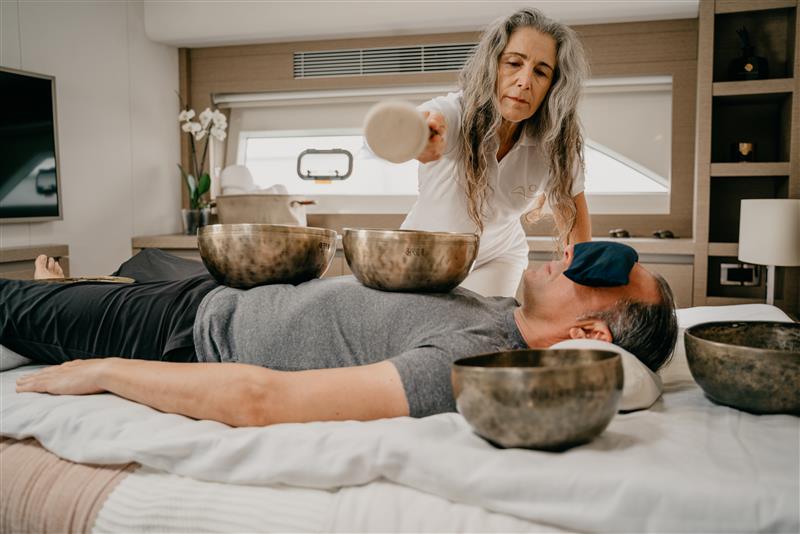
Sound healing operates on the principle that everything in the universe, including our bodies, is in a constant state of vibration. The specific vibrations and frequencies produced by sound healing instruments can directly influence our own vibrational state. This interaction can lead to numerous benefits, many of which have been studied and continue to be explored. Patricia Goméz, our expert sound healer, explains it like this: “The Tibetan singing bowls use frequencies, vibration and sound. The vibration works on the physical body, providing a cellular massage. The frequencies work on the brain, changing the wave productions. It is amazing, but it is simple.”
She went on to say, “sound healing works through the law of resonance.” What is that? The best example of the law of resonance is if you have old school clocks that operate on a pendulum together in the same room, eventually they will all sync. This happens because the vibrations they emit resonate together until they become the same frequency. This is one of the laws the universe functions on. When you bring the frequency of singing bowls near or on the human body, it acts in the same way. Eventually, the frequencies will meet each other. The sound harmonies the body. The effects of this balancing will vary person to person. But at the very least, this practice puts the body in a state of a parasympathetic state, the opposite of fight-or-flight.
Sound healing has showed its face in many different forms throughout history. It’s been practiced across various cultures for thousands of years, from chants and sounds that stimulate organs, to Tibetan singing bowls that change our frequency: the tradition of sound healing is as diverse as it is ancient. Goméz uses Tibetan bowls, which have their origins in Bon Po (often spelled as Bönpo), which is one of the oldest spiritual traditions in Tibet and predates the arrival of Buddhism.
They existed first outside of these beliefs, but it has always been “linked to healing,” says Goméz. In the teachings of Bon Po, it is believed that the illnesses and disturbances that arise in the body are a result of imbalance of energy. In order to restore the body, we must re-establish a harmonious relationship between our frequency and the worlds. Today, you will not find Tibetan singing bowls in Tibet, but spread across Northern India and Myanmar. Though we slowly see the spread of these eastern practices into the west’s wellness beliefs.
Sound healing is not just an alternative therapy but a complementary one, enhancing the efficacy of traditional medical treatments, particularly for mental health conditions such as anxiety, depression, and addition. This synergy is increasingly recognized by healthcare professionals, leading to partnerships that integrate sound healing into conventional treatment plans.
Such collaborations underscore the potential of sound healing to bridge the gap between alternative and mainstream medicine, offering a holistic approach that addresses both the symptoms and the underlying causes of various health issues. Goméz explains that “medicine works in the same way that sound does, the chemical reactions are changing the frequencies within the body to promote healing. Everything is about frequency.” Sound can work similarly to the prescription you pick up at the pharmacy.
After a comprehensive medical and physical analysis, a client can expect to explore holistic healing methods here at The Balance HealthCare Group. Our unique, individualized approach looks at the whole Being: mind, body, and soul. We take the best of the past, and innovate into the future of mental health and addiction treatment.
One of our most successful holistic therapies is thanks to our expert sound healer, Patricia Goméz, a student and now teacher of this practice for our twenty years. She found the art of sound healing by chance in the Himalayan mountains. “I fell in love with the vibration,” she tells me. In her practice at The Balance, she finds joy in watching people discover the transformational power of sound just like she did all those years ago. She begins her treatments with clients in the same way: providing an overall energy balance. From there, she uses her intuition and expertise to tailor the frequency to your vibration: finding the parts of you that are out of sync and putting you back into a state of balance.
While the scientific study around sound healing remains ongoing, the ancient practice is taking its rightful place in the modern day wellness conversation. The Balance HealthCare Group stands at the forefront of this movement, offering unparalleled sound healing experiences that cater to the holistic health needs of its affluent clients. As we continue to explore the vast potential of sound healing, we invite you to embark on a journey of discovery, embracing the transformative power of sound as a pathway to true well-being.
The Article
About This Article
✔ Medically Reviewed
✔ Evidence-Based Sources
✔ Updated Regularly
✔ Clinically Verified
This article was written by THE BALANCE’s clinical content team and reviewed by a licensed medical or mental health professional (such as an MD, psychiatrist, clinical psychologist, or equivalent). Our reviewers ensure that the information reflects current research, accepted medical guidelines, and best practices in mental health and addiction treatment. THE BALANCE’s medical editors draw on extensive real-world clinical experience supporting individuals in residential, outpatient, and luxury private treatment settings across Europe and internationally.
Editorial Standards & Integrity
THE BALANCE follows strict editorial and clinical review standards to ensure accuracy, balance, and reliability:
- All medical statements rely on authoritative sources such as the WHO, NIMH, APA, NHS, CDC, and SAMHSA
- Statistics use the most recent and reliable research available
- No medical or therapeutic claims are made without clear, verifiable evidence
- Content is reviewed and updated regularly to reflect evolving science, treatment guidelines, and clinical best practices
- Commercial interests do not influence clinical accuracy; all clinical insights are reviewed independently
- Recommendations include context, limitations, and alternatives where appropriate
How We Review Sources
- Our clinical writers and editors rely on:
- Peer-reviewed research and meta-analyses
- National and international treatment guidelines
- Professional bodies and regulatory authorities
- Verified public data from reputable institutions
We do not use anecdotal reports, unverified claims, or commercially biased sources. Every factual claim is supported by established evidence.
Conflicts of Interest
THE BALANCE provides private mental health and addiction treatment services. However, our clinical reviewers ensure that all content remains objective, non-promotional, and balanced. When discussing treatment options, we outline limitations, risks, and alternatives. Our priority is reader safety and informed decision-making.
How to Use This Information Safely
Mental health and addiction conditions are complex and vary significantly between individuals. The information in this article is provided for general educational purposes only and should not replace professional medical advice, diagnosis, or treatment. If you or someone you know is experiencing symptoms, seek guidance from a qualified healthcare professional. To maintain accuracy and trust, THE BALANCE updates articles regularly as new research and clinical guidance become available.
Do you need help?
If you’re struggling, you don’t have to handle it alone. Support is available - whether you’re feeling overwhelmed, anxious, depressed, or dealing with alcohol or drug-related concerns. If you feel unsafe, are at risk of harming yourself, or someone else is in immediate danger, contact your local emergency number immediately.
Talk to Someone Now (Free & Confidential)
Choose your country to find a trusted helpline near you:
Spain
- Suicide & emotional crisis helpline: 024 (24/7, free, multilingual)
- Samaritans in Spain: 900 525 100 (24/7)
Switzerland
- Die Dargebotene Hand / La Main Tendue: 143 (24/7)
- Pro Juventute (youth): 147
United Kingdom
- Samaritans: 116 123 (24/7, free)
- NHS urgent mental health support: call 111 (24/7)
United States
- 988 Suicide & Crisis Lifeline — call, text, or chat 988 (24/7)
Canada
- 9-8-8 Suicide Crisis Helpline — call or text 988 (24/7, nationwide)
- Talk Suicide Canada (alternate): 1-833-456-4566
France
- National suicide prevention number: 3114 (24/7, free)
Germany
- TelefonSeelsorge: 116 123
- Alternate numbers: 0800 111 0 111 / 0800 111 0 222
Italy
- Telefono Amico Italia: 800 860 022 or 02 2327 2327
Not an Emergency, but You Want Support?
If you’re not in immediate danger but are worried about yourself or someone you care about, reaching out early can make a meaningful difference.
Explore Care Options Near You
This website lists verified mental health professionals, addiction specialists, and treatment programs searchable by country and location. Use the “Find treatment” / “Providers” section to explore available options.
Or Reach Out to Us
If you’d like help understanding next steps, you can contact our team confidentially. We’ll listen without judgment and help you explore appropriate options.
Contact our team
- Phone: +41445005111
- Email: help@thebalance.clinic
- Availability: Mon–Sun, 07:00–22:00 CET
Not sure what to say? You can simply write: “I need help.” We’ll take it from there.