
Living a Life in Balance
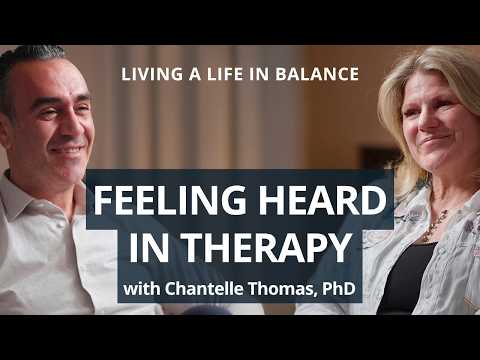
Feeling Heard in Therapy
With Chantelle Thomas, PhD
Chantelle Thomas joins Abdullah Boulad to explore trust, honest apologies, protective responses and the human relationship at the heart of therapy.
Listen to the conversation
Feeling Heard in Therapy
Chantelle Thomas, PhD
Inside this conversation
How family experience and cultural context shaped Chantelle’s professional path.
Why good intentions do not guarantee that someone feels safe or understood.
Apologizing with accountability rather than defending an intention.
More themes
- Making room for client feedback without abandoning professional boundaries.
- Understanding apparently resistant responses as potentially protective.
- Keeping clinical observations, research evidence and treatment claims distinct.
Find a moment
All chapters
The guest
Chantelle Thomas, PhD
Chantelle Thomas is a clinical psychologist and Executive Clinical Director at Windrose Recovery. Her professional work focuses on addiction, trauma and health psychology; her official biography also identifies her as a certified biofeedback practitioner. She hosts Blind Spots: Exploring What We Cannot See, a podcast examining overlooked aspects of recovery and relationships. Read her official professional biography and explore her podcast.
From the host
Reflections on the conversation
What stayed with me from this conversation
+
For me, the central question is not whether a therapist can be perfectly composed. It is whether the relationship can remain honest when something difficult happens. Chantelle returns to the responsibility of noticing our impact, especially when it differs from what we intended.
That theme reaches beyond the therapy room. Being understood is not the same as being agreed with, and caring about someone does not remove the need to listen when they say we have missed something.
The person behind the professional role
+
Chantelle describes an early interest in other people’s emotions and the family experiences that influenced her career. She also reflects on moving between South African, Canadian and Californian contexts, and on the ways culture shapes what feels familiar or difficult to discuss.
Her account is a reminder that a professional does not enter a relationship without a history. The relevant question is how that history is understood and managed, rather than assuming qualifications remove personal blind spots.
An apology that makes room for the other person
+
We spend time on the difference between acknowledging harm and explaining why it was not intended. Chantelle describes how Harriet Lerner’s work on apologies encouraged her to stay with another person’s experience instead of moving too quickly into self-defense.
The distinction matters: an apology can sound reassuring while still asking the hurt person to understand the speaker first. In this discussion, accountability means being willing to hear more, acknowledge what was missed and consider what needs to change.
Authenticity is not the absence of boundaries
+
Chantelle questions the performance of a detached, flawless professional persona. She describes wanting a therapeutic relationship in which warmth and honesty are real, rather than simply a particular tone of voice.
We also discuss the tension between openness and responsibility. The client should not be expected to look after the therapist’s emotions. Being human within a professional role still involves appropriate limits, attention to power and a focus on the person seeking care.
Listening when feedback is uncomfortable
+
One practical part of the conversation concerns how a whole team responds when someone raises a concern. Chantelle describes encouraging staff not to automatically defend a colleague or the program before understanding the client’s experience.
Listening does not require instantly deciding who is right. It means making room for the concern, examining what happened and responding responsibly. She also discusses how behavior labeled resistant may be protective, inviting curiosity without removing necessary boundaries.
What the discussion of psychedelic-assisted work does—and does not—show
+
Chantelle explains how participation in clinical research influenced her attention to preparation, consent and the therapeutic relationship. When describing ketamine-assisted work in residential care, she emphasizes selection, existing trust and continuing support rather than using a substance to force an emotional opening.
A particularly important qualification comes later: she says her clinic’s follow-up information had not yet been formally analyzed and describes limitations in comparison and follow-up. Her positive observations are not a controlled demonstration of effectiveness, a success rate or a guarantee of safety.
Feeling seen, rather than expecting a quick fix
+
When speaking about her own experience, Chantelle describes the importance of feeling understood during the integration that followed a research session. The emphasis is not on one experience magically resolving everything, but on what becomes possible within an ongoing relationship.
I return to the same question that runs through the episode: can we make room for the person, not only the problem? This is an invitation to reflect on listening and accountability, not a recommendation to pursue a particular medicine or attempt treatment without qualified care.
The full transcript
Original-language transcript · EN