
Living a Life in Balance
Vetenskapen om interoception: hur kroppen formar känslorna med professor Manos Tsakiris
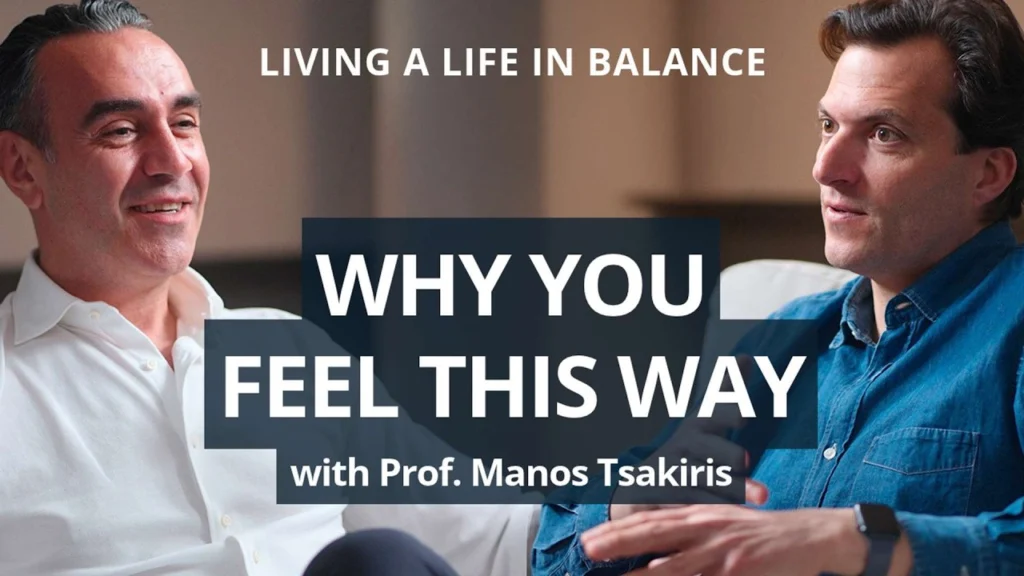
Med professor Manos Tsakiris
Professor Manos Tsakiris samtalar med programledaren Abdullah Boulad om interoception, känslan av att kroppen är ens egen, känslomässig medvetenhet, relationer och det politiska livets kroppsliga dimensioner.
Lyssna på samtalet
Vetenskapen om interoception: hur kroppen formar känslorna med professor Manos Tsakiris
professor Manos Tsakiris
I det här samtalet
Varför känslan av att en kropp tillhör någon beror på hur hjärnan sammanför sinnesinformation.
Vad interoception innebär och varför det är olika saker att upptäcka en kroppslig signal, rikta uppmärksamheten mot den och förstå den.
Hur Tsakiris ser på tidig omsorg, känslomässig utveckling och skillnaden mellan empati och känslosmitta.
Fler teman
- Varför samtal om terapi, mindfulness, yoga och biofeedback behöver ta hänsyn till individuella skillnader och evidensens begränsningar.
- Hur relationer kan hjälpa människor att tolka känslor utöver vad mätningar och digitala verktyg kan erbjuda.
- Hur gästen kopplar kroppsliga förnimmelser till politiska känslor, tillit och samhällsdeltagande.
Hitta ett avsnitt i samtalet
Alla kapitel
Gästen
professor Manos Tsakiris
Manos Tsakiris är professor i psykologi vid Royal Holloway, University of London, där han leder Lab of Action & Body. Han leder även Centre for the Politics of Feelings vid School of Advanced Study, University of London. Hans tvärvetenskapliga forskning undersöker kroppslig självmedvetenhet, interoception, social kognition och sociopolitiskt beteende. Hans officiella biografi och forskarprofil vid universitetet ger ytterligare bakgrund. Tillsammans med Helena De Preester är han redaktör för The Interoceptive Mind: From Homeostasis to Awareness. Han medverkar som gästande forskare, inte som kliniker vid THE BALANCE; medverkan innebär inte någon anställning eller något stöd för verksamheten.
Från värden
Reflektioner kring samtalet
Översikt över avsnittet
+
Människor beskriver ofta sig själva genom minnen, ambitioner, relationer och övertygelser. Tsakiris föreslår en kompletterande utgångspunkt: den fortgående upplevelsen av en levande kropp. Hunger, trötthet, smärta och andra kroppsliga tillstånd utgör en del av det sammanhang där tankar och känslor uppstår. Enligt hans synsätt är vår kroppsliga förankring en grund för självmedvetandet, inte en fullständig förklaring till allt som gör en människa till den hon är.
Avsnittet följer denna fråga från laboratorieexperiment till vardagliga relationer och samhällsliv. Det upprätthåller också en viktig åtskillnad: att förklara en möjlig psykologisk mekanism är inte detsamma som att påvisa en behandlingseffekt. Tsakiris lyfter återkommande fram öppna frågor, individuella skillnader och begränsningar i vilka slutsatser forskare kan dra av specifika mått på kroppsmedvetenhet.
Från existentiella frågor till experimentell psykologi
+
Tsakiris minns att han redan i de tidiga tonåren ville ägna sig åt ett akademiskt liv. Han beskriver hur läsningen av Albert Camus och samtal med sin gudfar, som var psykiater, påverkade hans intresse för varför människor är som de är. Detta är gästens berättelse om sin egen intellektuella utveckling, inte reflektioner som tillskrivs programledaren.
Hans utbildning förenade psykologi i Aten, filosofi med inriktning på psykisk störning vid King’s College London samt kognitiv neuropsykologi och forskarutbildning vid UCL. I samtalet förklarar han varför studier av hjärnans representation av kroppen blev ett sätt att undersöka självet experimentellt. Han skiljer uttryckligen detta arbete från att ta emot neuropsykologiska patienter eller bedriva terapi.
Känslan av att kroppen är ens egen och gummihandsillusionen
+
Känslan av att en hand tillhör en själv kan verka alltför självklar för att behöva förklaras. Tsakiris beskriver hur forskare undersöker den med hjälp av gummihandsillusionen: under kontrollerade förhållanden kan synkroniserad beröring av en synlig konstgjord hand och en dold verklig hand förändra deltagarens uppgivna känsla av att handen är den egna. Jämförelsen med beröring som inte är synkroniserad hjälper forskare att studera hur synintryck och kroppsliga förnimmelser integreras.
Han menar att denna flexibilitet inte enbart bör förstås som att hjärnan fungerar fel. Hjärnan arbetar med sinnesinformation och tidigare erfarenheter, och dess representation av kroppen måste kunna anpassas till förändring. Experimentet belyser en fråga om perception; det är inte ett diagnostiskt test för lyssnare, ett belägg för att alla upplevelser är opålitliga eller en behandling för trauma.
Interoception: att förnimma kroppen inifrån
+
Diskussionen går sedan från att betrakta kroppen till att förnimma dess inre tillstånd. Interoception handlar om information inifrån kroppen och hur den bearbetas, inklusive processer utanför det medvetna. Tsakiris använder dialogen mellan hjärtat och hjärnan för att förklara varför kroppens fysiologiska tillstånd har betydelse för det sammanhang där vi känner och tänker.
Han skiljer mellan flera dimensioner som lätt flyter ihop i vardagligt språk: träffsäkerhet i att upptäcka signaler, hur mycket uppmärksamhet någon riktar mot dem och insikt i hur tillförlitliga de egna bedömningarna är. Att känna sig säker på ett kroppsligt intryck är inte automatiskt detsamma som att mäta det korrekt. Inte heller visar prestationen i en uppgift som gäller hjärtslag hur väl någon uppfattar alla andra inre signaler. Denna åtskillnad är central i avsnittets diskussion om kroppsmedvetenhet.
Omsorg, känslomässig utveckling och empati
+
Tsakiris presenterar en utvecklingspsykologisk hypotes där samspelet mellan spädbarn och omsorgspersoner hjälper barn att lära sig sambandet mellan kroppsliga behov och de svar som tillgodoser dem. Han diskuterar hur svåra uppväxtförhållanden eller bristande anpassning i gensvaret skulle kunna försvåra detta lärande. Dessa förklaringar ska inte läsas som en diagnos av ett visst barn eller en viss förälder, ett påstående om att ett enskilt samspel avgör den framtida hälsan eller en enda förklaring till traumats konsekvenser.
Han skiljer också mellan empati och känslosmitta. Enligt hans beskrivning innebär empati att förhålla sig till en annan människas upplevelse och samtidigt förstå att den förblir den andras upplevelse; känslosmitta beskriver en annan process där känslor sprids mellan människor. Diskussionen knyter kroppsmedvetenhet till gränsen mellan självet och andra, utan att antyda att en människas empati kan bedömas utifrån hur tydligt hon känner sina hjärtslag.
Terapi, kroppsmedvetenhet och evidensens begränsningar
+
På frågan om hur kroppsmedvetenhet kan förbättras diskuterar Tsakiris samtalsterapier, kroppsinriktade metoder, mindfulness, yoga och biofeedback som olika möjligheter snarare än en universell rekommendation. Han betonar hur väl en metod passar den enskilda personen. Han påpekar också att förändrad tilltro till eller medvetenhet om den egna prestationen inte behöver innebära att den objektiva träffsäkerheten i att upptäcka signaler har förbättrats.
Diskussionen om vagusnerven och insula placerar dem i en bredare dialog mellan kropp och hjärna, inte som en enda strömbrytare som enkelt kan återställas. På frågan om hjärnstimulering säger Tsakiris att han inte känner till några avgörande studier som visar att dessa metoder förbättrar interoception. Han beskriver också osäkerheten kring huruvida förbättringar i en kroppslig uppgift kan överföras till en annan. Avsnittet fastställer inget kliniskt protokoll och garanterar inte nytta av någon insats.
Relationer, kroppslig information och det digitala livet
+
En återkommande poäng är att mer data om kroppen inte behöver ge en djupare förståelse av den levda erfarenheten. Tsakiris ställer tillgång till mätningar från klockor eller andra enheter mot att lära sig om känslor genom relationer. Han lyfter fram beröring, röst, uttryck och upplevelsen av att bli förstådd som aspekter av samspel som inte kan reduceras till ett fysiologiskt mätvärde.
Deltagarna undersöker också tillit till digitala medier och artificiell intelligens. Boulad tar upp värdet av att ifrågasätta äktheten, medan Tsakiris pekar på den belastning det innebär att ständigt tvivla på det man möter. I deras diskussion behandlas digital kompetens, gemensamma upplevelser och social kontakt som sammanhängande frågor. Detta är deltagarnas tolkningar, inte ett påstående om att varje digital interaktion är skadlig eller att teknik kan ersätta professionell vård.
Politiska känslor, samhällsliv och att agera genomtänkt snarare än att reagera
+
I den avslutande delen förklarar Tsakiris forskningsfrågorna bakom Centre for the Politics of Feelings. Han beskriver studier där kroppskartor används för att fråga var deltagarna upplever känslor förknippade med politiska och vardagliga situationer. Han diskuterar samband mellan den rapporterade kroppsliga påverkan av politiska känslor och samhällsengagemang. Detta är forskningsresultat och tolkningar på gruppnivå, inte ett sätt att dra slutsatser om en individs politiska åsikter utifrån kroppsliga förnimmelser.
Samtalet vidgas till polarisering, demokratisk styrning och ungas deltagande. Åsikter om rösträttsålder presenteras som talarnas uppfattningar, inte som en redogörelse för gällande lag eller en klinisk rekommendation. Tsakiris avslutar med att betona utrymmet mellan att känna en stark känsla och att bestämma hur man ska agera. Hans personliga beskrivning av balans omfattar familj, vänner och tennis; artikeln gör inte dessa preferenser till en rekommendation för andra.
Hela transkriptionen
Transkription på originalspråket · EN
Läs transkriptionen
I was probably around 14 years old when I decided that I want to become an academic. You know, there was this nagging question about why we are the way we are. Did you get an answer to that question? Fragments, fragments of answers. The basic entry point of understanding who we are is not recognition, but it is our body. I believe that life is felt before it is understood. Traumatic experiences in early life will lead to people having poor interception of not being able to actually feel much from their bodies. Improve the conditions that will enable people to actually feel.
Enable the conditions for people to actually meet and feel together and regulate each other. Be in a position to respond rather than react. There's nothing wrong in feeling strong emotions. Feel them and then decide what to do, responding rather than reacting. Yes. All of your interceptive sensations are being mapped onto the insula. But that's not the whole story.
Welcome to the Living a Life and Balance podcast. My name is Abdullah Bulad. I'm the founder and CEO of the Balance Rehab Clinic. My guest today is Dr. Manus Tsakiris. He's a leading psychology and neuroscience researcher on how the body gives rise to the sense of self and identity. I hope you will enjoy. Manus, what motivated you to do what you do today?
I was probably around 14 years old when I decided that I want to become an academic. I want to become some sort of professor. And I think I was between psychology, philosophy, and psychiatry. Eventually, psychology won over the other disciplines. And I think for some reason, when I started reading books, and I still remember the first book that I read that made a huge impact on me, and we can talk about it, you know, there was this nagging question about how why we are the way we are. You know, how come we came to be the way we are? And of course psychology is a is a very wonderful discipline that offers many different entry points to this question.
As I came to realize over 25 years of research that I've been doing right now. So if you like, you know, the motivation was always to understand, you know, who we are, the self-awareness question, which of course goes way back to the history of humanity uh and and philosophers, that many of them came from my home country, which is Greece.
Yes.
Yeah, so did you get an answer to that question? Fragments, fragments of answers. Uh it would have been really disappointing if I had found the answer, because what would I do next, right? So there's so many different ways in which you can think about the question of self-identity. And I guess if we were to ask five random people in the street, you know, how do you define yourself? What they would tell you. They would tell you, you know, their name, they will tell you that it's their memories of you know where they grew up, um, they will tell you about their dreams and their fears, things that are quite mental and cognitive in some ways.
But I I felt and I started thinking and following other people, of course, who wrote about it that the basic entry point of understanding who we are is not our cognition, it's not our brain, but it is our body. Now, for most people, that may sound a bit um counterintuitive. The thing that we identify with is our mental life, right? Which probably is produced by our brain. But the brain is only occupied with this question of our mental life for a very small amount of time and only consumes a very small amount of energy to keep us thinking.
Most of the energy that the brain is actually consuming is about keeping this body alive. I think the core of who we are has to do with the experience of this body that we have, which is of course the main means by which we perceive the world. So if you like, the starting point of the self, not the whole story, but the starting point should be the experience of our own body.
So your understanding is our mental capacity or identity is here to experience the physical body and the physical world uh around it.
And it is also the product of this body. Um, I believe that life is felt before it is understood, and it is felt through the body. And the only reason why we actually get out of the bed in the morning is because we have this kind of physiological states that are, of course, fundamental for the survival of the organism, things like you know, hunger and thirst, and fatigue or energy and sexual arousal or pain. These are basic homeostatic states that actually uh motivate us to act. And it's on the base of these feeling states that we start experiencing emotions, which actually provide probably the starting point for our cognition, you know, the why we think the way we think.
At the age of 14, not many uh children would uh become philosophical and try to understand uh why we live and why we are here on earth, right? So, was there any any um ancient philosopher or uh anything special which motivated you to dive into that question?
So there were a couple of things. First of all, not an ancient philosopher, but a French existentialist. So I still remember that my brother gave me as a present The Stranger Belbert Camus Camus, and um, you know, of course, he was not just a novelist, he was also a philosopher, and he wrote both novels and uh philosophical books. And this idea that you know there's no meaning in life unless you try to find the meaning and give it to it, that you know, there's no God, there's no supernatural structure, and it is up to the way in which we deal with our existence that you will find a meaning in life.
That was, you know, quite a quite compelling message at the time, you know, my early teens, yeah, teenager uh years. And then I started reading all sorts of books, and that was one big influence. And the second biggest influence was my godfather, who's a psychiatrist and was a best friend of my parents, so he was very often at our place and we're having long discussions, and he, given his profession, he he offered me a new way of looking at at uh at human beings and human existence. So I think my motivation to go and study psychology eventually was very much down to to his influence.
And I'm not claiming that at the age of 14 I found many answers, but I I followed I followed the thread, and I you know I I started having questions that needed some kind of answer.
Yeah, it's fascinating. Um, I mean, then you went on to to study psychology. Yes. And what was what was then further specialization you went into?
So I studied psychology at the university in Athens, and psychology in the Greek um academic system is much closer to social sciences than it is to life sciences. And we had a lot of um courses on social psychology and clinical psychology and psychoanalysis, which I very much was interested in. And we didn't hear much about the brain. So I had no idea that, you know, I mean, I had some idea, but you know, the focus of the education I got in Greece was not about the brain and the nervous system. So when I finished my degree, I did what most um young Greeks do.
I went abroad for postgraduate studies. And because I always wanted to study a bit of philosophy, the first master's that I did when I went to London in 1999 was a master's that was jointly taught by the Institute of Psychiatry at King's College and the Department of Philosophy at King's College. And the title of the master's was Philosophy of Mental Disorder. In other words, the question of the whole master's degree was how do you define mental disorder? And trying to bring together threads from philosophy as well as psychiatry and psychopathology. And it is a very interesting experience because, as part of the courses that I was being taught, I heard for the first time a lot about the brain.
Even though it was a philosophy course, I was exposed to many theories about the function of the brain and the nervous system. And then once I finished that master's, I decided that you know the brain is probably something quite interesting as an organ that I should try to study a bit better. So then I did a second master's at UCL, this time on cognitive neuropsychology, where I got more formal training on, you know, a range of cognitive functions and the neural underpinnings. And that led me to the PhD that I completed at the Institute of Cognitive Neuroscience again at UCL, which was partly psychology and partly cognitive neuroscience.
And the focus of the PhD was uh this idea that the body and the experience of the body and how the body is represented in the brain is scaffolding our sense of identity and our sense of self.
That's that's a lot uh we can talk about from a neuroscience perspective, but also all the uh subtopics of uh psychology. What in what was your your most interested topic when you you when you looked at the brain and what fascinated you to study neuroscience?
Yes. The fascinating question for me at that point was precisely how the body is represented in the brain. There's a very nice phrase by William James, who's considered to be the father of modern psychology, who wrote in The Principles of Psychology that we experience the same old body always there. And if you like, this permanence of the body is unlike any other object. So the body is not like any other object that we have in the world, it's constantly with us, it's the background against which we experience life.
Yeah.
And we take it for granted. But you know, when you start studying the brain, you need to assume that nothing can be taken for granted. So there are specific processes by which the brain will build this experience of this body as belonging to you. In our scientific jargon, we call that the sense of body ownership, the feeling that this body belongs to me and it's mine in a way that no other object in the world is experienced with this same kind of immediacy that this is mine.
Yeah.
So the question, if you like, is how does the brain actually create this sense of body ownership? And it is a fascinating question because we know that people who may have a brain damage in a particular part of the brain, they may lose this sense of body ownership. They may start feeling, for example, that their left arm belongs to somebody else. Okay. And, you know, this is not in the realm of um somebody being mentally disordered. This is an acute consequence of a brain damage in a particular brain area. Okay.
So in in neuropsychology, this is called somatoparaphrenia. It's the feeling of ownership over your limb. And you know, you will see these patients that you say, you know, it typically it occurs after a right hemisphere damage that often results in a left side paralysis. And some of these patients who are paralyzed on the left side, only some of them they also experience this loss of ownership. And then when you ask them, you know, whose hand is this one? Quite often they will tell you, Oh, oh, well, I think it's my husband's hand, or it's my wife's hand, or it's the doctor's or the nurse's hand, but it's not mine.
Okay.
And that's fascinating.
Even though cognitively, logically, they see it connected, yes. They don't recognize it as its own.
Yes. But and the movements would be that there's no movement because typically from the right hemisphere damage there is a paralysis. But not everybody who has a paralysis on the left side of the body will also experience this loss of body ownership, right? So one question is no, which brain area is particularly involved in that feeling of body ownership, that this hand, this body part, belongs to me. And the second question is under normal circumstances, how does the brain experience that you know these limbs belong to you?
Yes.
So I'm not somebody who's um seeing neuropsychological patients. Uh, I didn't become a neuropsychologist, I became an experimental psychologist and a cognitive neuroscientist. And the typical way in which we have in in psychology to study things is to do experiments. But the question is, how do you experiment with something that under normal circumstances is always there, your body. So typically in psychology, if we want to run an experiment, we will have two conditions. One condition where the phenomenon that you investigate is present, and another condition where the phenomenon that you investigate is absent, and you compare the two conditions.
Now, in the case of body ownership, it's not easy to do that, right? You cannot erase the body from one uh uh from somebody's experience. So quite often we rely on illusions, and most people are aware of visual illusions, like the Mueller-Layer illusion, where you see two lines of equal length, but because of the arrows pointing to different directions, you feel that one line is longer than the other one.
Yeah.
Now, is there an illusion that we can use to actually experiment with this sense of body ownership? I was lucky because when I started doing my PhD, there was one paper that came out by Matthew Badvinick and Jonathan Cohen in Nature, where they described an illusion, which they called it the rubber hand illusion. And it's a fun experience, it's something that you can probably try at home. Um, but we tried it in the lab, and it goes as follows. So we ask people to come in the lab and we ask them to sit in front of a table.
Yes.
Right? And we cover their arms so they cannot directly see their arms and their hand, and we place a fake hand in front of them, right? It's an obviously fake hand, there's no question about it. Everybody will look at it and say, no, that's a fake hand. And then what we do is that we ask them to pay attention to the fake hand in front of them, and they're not allowed to move their left hand. And then me as the experimenter will take two paintbrushes and I will start stroking both hands at the same time and exactly the same location. So, what is happening now is that our participants they see a fake hand in front of them that is being touched at the same time as their own unseen hand.
Because remember, they cannot see their own hand. Yes. Now that creates a conflict for the brain. Why? Because you see something happening on a on a hand in front of you, and at the same time you feel something very similar happening on your own hand, which you cannot see. And typically the brain expects that when you feel touch on your own hand, you will also see touch.
Yeah.
But that's not what is happening here because with our setup, we have dissociated the vision of touch on the fake hand in front of you, and the feeling of touch. The brain doesn't like conflicts. Right? Yeah. And the brain will try to solve the conflict. And we know that different senses carry different weight. We say that you know we tend to believe in what we see, right? And what is happening in this situation is that after, let's say, 30 seconds or 40 seconds, where I touch at the same time both hands, and you see touch on one location on the fake hand, and you feel touch on another location, the brain will start relying more on the vision of touch.
It is as if vision dominates over the feeling of touch that you have. If there are because there are also no other sensations coming from the original. Exactly, exactly. Your hand, your own hand is still, it's immobile, and you cannot see it, right? So the brain will start assuming that what you actually feel on your own hand is caused by what you see on the hand in front of you.
Yes.
And if this is the origin of your sensation, your brain will start referring to the sensation of touch on the fake hand in front of you. So if the sensations that you're having are coming from what you see in front of you, then the brain will assume that this is your actual real hand.
Which in this case we would rely more on the visual, uh on the visual what we see uh rather than what we feel.
Exactly. But there's a trick here, and the trick is that these two events are temporary temporarily synchronized. You feel touch and you see touch at the same time. If I stroke the two hands out of synchrony, you don't experience the illusion. So what happens is that after 30 seconds or 40 seconds of synchronized visual and tactile stroking of both hands, you start feeling that the fake hand is now part of your body. Yeah. And that comes at the expense of your own real hand. Just to give you one fascinating finding, when people experience that the fake hand is part of their own body, the temperature on their own unseen hand drops.
That's a fascinating finding because temperature is a homeostatic regulation mechanism. And there's no way that you can voluntarily decrease the temperature in your own hand. So what is happening is that because your brain now has a new hand that is replacing the experience of your own real hand, it downregulates the homeostase in your own hand. Because it has diverted all its attention and its resources to this fake hand. So starting from that illusion, you know, we've we've done a lot of studies looking at what are the neural correlates. And what was fascinating is that we find that when you put people inside an MRI scanner where you can see how the brain is engaged in this experience of owning this fake hand, you find activity in the right insula.
The insula on the right hemisphere is buried within the frontal cortex. And this is also the brain area that is most commonly lesioned for people that have somatoparophrenia, that lose this sense of body ownership. So we started with this kind of um experiments of bodily illusions to understand a bit the mechanism of how the brain constructs in real time and almost constantly the experience of your own body as belonging to you through the multi-sensory integration, through combining, bringing together vision, touch, and eventually other senses like proprioception and interoception.
I ask myself, uh I have seen that um on the on the internet, social media, that there are some tests uh which uh show that it's it has been always fascinating to me how our brain can adapt to to this circumstance. Um the the question is, or the question I ask myself then, how can we then rely on our brain if if it's if it can misinterpret what is happening around us or what is belonging to us?
It's a good question, but I'm not sure whether I will call it a misinterpretation. Um because in one sense the brain can only go with what is the available sensory evidence and what are the prior models that you have. What I mean by prior models is that you have a lifetime of experience of, you know, when you move your hand and you see it in front of you, everything is happening in the same place at the same time. You know, vision, touch, perception, they're all combined in space and time, right? So by creating an artificial situation, we ask the brain to recompute these events and try to align them both in space and time.
Most often than not, things go according to plan, and your brain doesn't have to assume that, you know, my brain doesn't have to assume that, you know, your hand is my hand. From an evolutionary perspective, it also makes sense that whatever is represented in our brain is not fixed, but it is a bit male that it allows to changes, for changes to be incorporated and for the model to be updated. And you can think about it in um in longer timescales.
As we grow up, our bodies changing in in size, in shape. Um we age. And I I quite often think that you know if I close my eyes now and I try to bring my face into my mind's eye, probably the kind of mental image that I have is of a younger manus. Because it takes time to update and assimilate the changes. But the brain needs to have that capacity to use the available sensory evidence to update. But that's only part of the story.
This ability that we have to update, these malleable body representations is what Part of the story because at the same time you you have the sense of continuity, you know, you still feel that it is your own body, even though it is changing. And that's where you know the story will take us to a different entry point to body awareness, which is not how you perceive the body from the outside, like when you see yourself in the mirror or when you see your hand in front of you, but how do you feel the body from within? So, on the one hand, you have exteroception, and what I mean by exteroception is this external perspective or external perception on one's own body, and then you have interoception, which is the awareness of the internal states of the body.
What I ask myself is also how the body affects the brain uh in a way, if I think about the nervous system and then mental health, we we speak also about uh uh about that and the connection and how how this is is affecting mental health or how trauma is within within our body. How can the body affect how is this connection between our brain and our bodies? Yes.
I I think the answer to this question goes to this um idea of interoception. First of all, a disclaimer. What I'm gonna say doesn't come from my experience working with clients or patients because I don't have any experience working with clients or patients. Uh I'm doing basic science research in a psychology lab, but we have been studying in in depth um this idea of how the body and signals from the body influence both the way we feel, the way we regulate our emotions, and the way we think, our cognition.
And interoception at a purely physiological level concerns the stability and the survival, if you like, of the organism. So it's all these kind of physiological mechanisms that are in place and are almost always at play to regulate our bodily function. So think about you know, when you move from a stand from a sitting position to a standing position, your blood pressure needs to be regulated, otherwise, you would fall on the ground, right? So this is an interoceptive uh mechanism. So at the physiological level, interoception happens below our level of conscious awareness and it regulates our blood pressure, our uh heart rate, our breathing, and all sorts of functions.
There is this constant dialogue happening between the viscera, the internal body, and your brain. You know, just to take an example of the heart and the brain, and Darwin called them these two most important organs of the body, they're in a constant dialogue. On every single heartbeat, your heart is sending signals to the brain that informs the brain about the physiological context within which cognition takes place. And at the same time, the brain is trying to regulate your heart rate so that it stays within some kind of safe limits.
So yeah, so it's you have this constant dialogue. Now, for the brain, of course, it's very important to know what is the context within which it's working, right? You know, is your body feeling safe? Is your body well? Is it tired? You know, does it have enough resources and so on? Because as I said, probably 80% of the brain's energy consumption goes to regulating the body.
Yes.
So by studying this dialogue, we can actually understand exactly what you were saying. You know, how does the body influence the brain? And in addition to this ongoing dialogue that happens below our levels of conscious awareness, you know, I'm not constantly aware of my heart rate, and I don't really know exactly when my heart is beating versus when my heart is silent. These are the automatic functions. These are the automatics. There's no doubt that we are also aware or we can become aware of how it feels like, right? I mean, that's why you feel hunger.
Because at some point, when your blood glucose levels signal that, you will start feeling thirsty or hunger and so on. So we call that interoceptive accuracy or awareness, which is how sensitive and how accurate people are reading out the internal states of their bodies. And to me, this is a fascinating question because we do find that in the normal population there's a very wide range of um, there's a very wide variance, right? Some people are really good at tracking what is going on in the bodies, and some people are not so good.
Why is that so? What do you think is the origin why people are individually not capable to sense um the body activities or needs?
We don't have a definite answer, surprisingly. Or perhaps it's not so surprising because even though the term interoception was coined by Sherrington in 1906, most of the research that has been happening in the area started around 2000. So we only have about 26-25 years of research in that area. And of course, there will be some kind of genetic predispositions, but we do know that the early years of life are crucially important.
We know that traumatic experiences in early life will lead to people having poor interception of not being able to actually feel much from their bodies. And one hypothesis that we put forward together with my colleague Katarina Fotopullu is that the early life caregiver infant interactions are crucial for enabling the individual, which I don't like as a word, and I will explain why, to build a model of their own body, of their interoceptive body.
And let me let me just illustrate that with an example. Um we know that human beings, when they're born, they are totally motorically immature. Babies cannot feed themselves, but that's just the beginning, you know, they cannot thermoregulate themselves, but that takes eight years to actually mature in the brain, the thermoregulation mechanism. And nevertheless, this organism has to stay alive, right? So the baby has a very limited behavioral repertoire, they will cry and they will cry because they're hungry, or because they're in pain, because you know they're just fussy, or because they're tired, but they cannot actually regulate this interoceptive need themselves.
They have to rely on the caregiver, right? And in a way, the caregiver needs to do a bit of predictive coding of inferring what is the cause of the infant's interoceptive state, why is it that the infant is now crying? Is it because they're hungry or because they're in pain? And this is where the caregiver's response is crucial because if the baby is in pain, but the caregiver thinks that the baby is hungry and tries to feed it rather than comfort it for its pain, it doesn't allow the right kind of stimulus to actually perform its role, which will be homeostasis, to regulate the body.
But you know, through this interaction, which is very much embodied, and as long as the caregiver is good enough in inferring what is the underlying cause of the infant's crying or of the infants in the receptive state, the caregiver will enable the infant to start building a more or less good model of the body, which goes like when I experience X, this is what I need.
Yeah, the needs are met quicker. So uh problematic, it gets what that's what what you're saying uh is when my needs are not met. Exactly. What happens then within the body of this child that's uh now in this case, if it the needs are not met?
Well, first of all, confusion, a prolongment of the interoceptive dysregulation because you don't get the right kind of stimulus from the environment that will meet your interoceptive needs and demands.
Yes.
Over a longer period of time, a lack of confidence in what your body is telling you. This is one scenario, you know. And then, of course, there are cases where there are traumatic events where the body will just shut down because that's the kind of safest way for the body to survive.
As a protection. Yes. But probably it also has affect this uh if this co-regulation doesn't exist at this young age, it may also affect the mental health or uh the emotional side of this child. Yes, the same way it would um when the body needs now are not met. Yes, exactly.
And we we see that from lots of studies that look at people's capacity to become aware of internal states of the body, like the heartbeat, in adulthood, that this ability correlates with emotion regulation, uh, with self-ather boundaries, with your capacity to take somebody else, some someone else's perspective. So people who are more interceptively aware, the ones who can track a bit better what is going on inside them, they will be better capable of regulating their emotions and also better capable of showing empathy and understanding someone else's emotional experiences.
And that is crucial because empathy, unlike emotional contagion, empathy requires to recognize the other as a subject who is different from you. And when you empathize, you shouldn't make you shouldn't be making the other person's emotional state yours, but you should be able to relate to it for what it is, the affective state of someone else. And I'm saying that because quite often people confuse empathy with emotional contagion, which is, you know, you're in pain, I'm in pain, you know, you're smiling, I will smile. And of course, these things happen.
Yes.
But you see that in this kind of case, the self-other boundaries are being dissolved. You know, I may not really realize why I'm in that kind of state. It's just because I'm mapping what you're feeling onto my own body. But true empathy requires this kind of good distance between self and other and recognizing that you know we are two different subjects having you know different experiences, but nevertheless, I'm capable of actually empathizing.
And usually people who are better in sensing their own body, they are also good at being more compassionate and uh empathetic. Yes.
There is this inverse relationship between the quality of somebody's interoception and the quality or their tendency to perceive the body from the outside through extra reception. So, you know, I spoke about the rubber hand illusion, this question of body ownership and how the brain is using external signals like vision and touch to create one aspect of our body awareness, which is mainly about, you know, my body image. What we find is that people who are not so good at recognizing internal states of the body, like the heartbeat and the breathing and so on, they're relying more on the perception of the body from the outside.
And you can see that also in the cases of body image dissatisfaction. So people who don't, who are not so accurate in their interoceptive representations, who don't know much about what goes on inside them, they may be more dissatisfied with how their body looks like, they may be more likely to objectify their appearance, and it's also something that we find in both subclinical and clinical uh symptomatology of eating disorders and body image disorders. So if you like you have this kind of inverse relationship, on the one hand, you know, it seems that you know interoception provides some kind of protection and resilience to this emphasis that our culture is also putting on the external appearance, appearance of the self.
Which adds then to possibly the lack of attunement during infant and uh young uh young young age and genetics, obviously. Yes can be also affect. Yeah, fascinating. Um, which then also speaks to how people eventually um are affected differently by by life circumstances like traumatic experiences uh and so on. Um so so they are more emotionally fragile because because and it's connected to the lack of connection of the body.
However, how can this be I don't want to say fixed, but but improved, like the body sensation improved if there was a lack of attunement uh in childhood?
I think as it happens with most things relating to mental health and well-being, uh quite often you need the right kind of compatibility between the individual and the kind of intervention or or therapy that would work for them. You can think about talking therapies that will have an important impact on actually giving the tools to people to mentalize their interceptive states, in other words, to give meaning, to make sense of what it feels like. You can think about cases where there may be more somatic uh-based approaches, uh therapeutic approaches.
You can think about things that people probably do quite a lot in their everyday life, which could be mindfulness or yoga. Um and then, you know, there are instances where biofeedback could also be valuable and helpful. And I'm saying that, you know, different approaches would work for different people, and I'm I I'm really a true believer of that. Uh, you know, I I have a lot of friends and colleagues who are therapists. Uh, I have a lot of friends and colleagues who are in therapy. And what I keep hearing is that, you know, this kind of thing actually worked for me, and this approach didn't work for me.
Yes.
And there has to be this kind of um compatibility. Um, but I think you know, the other fascinating thing about interoception, and that makes it quite complex, is that it has many different levels or dimensions because you can think about the purely bottom-up physiological level, which is you know the impact of the signal from the viscera to the brain. And that, of course, may differ uh across the population. Then you have this level of interoceptive accuracy where you are able to actually perceive things, but then you have higher up levels of you know your sensibility, how much do you pay attention to it, your metacognitive awareness, you know, whether you feel that you're good or bad at reading out your body.
And for some things like mindfulness, for example, the findings are that mindfulness interventions don't improve interoceptive accuracy per se, but they improve your metacognition. In other words, after you've done mindfulness, you're better capable of knowing whether you're good or bad at reading out your body. Okay. Which is also a valuable thing because you need to know about your performance. That's a good thing to have in life in general, to know how good or bad you're at things. Because you can use that to actually make an informed judgment about how much you should trust your gut feelings.
Yes. Because if you know that you're not good at it, maybe you shouldn't follow your gut feelings.
And how is the nervous system related to interception? Uh, how does what what what role does it play? Because in trauma, we we speak a lot also about dysregulated nervous system and uh safety and and um and regulation. How how does it play in your perspective?
Well, I mean, of course, you know, the vagus nerve plays a huge role as one of the main you know avenues of this two-way dialogue between the the viscera and and the brain, and it's interesting because there is a debate in the neuroscience community as to whether you know one we should be looking at more subcortical brain structures that are in this constant dialogue with the autonomic nervous system or the peripheral nervous system, or whether one should be looking at more cortical areas. Uh I believe that there is quite a lot of evidence right now in the field that the insula, a brain area for which we talked about before, plays a crucial role, a crucial role in bringing together these different aspects of your body awareness and underpinning, if you like, a more global representation of our material self.
I think this is a beautiful phrase of Bart Craig, a neuroscientist who did a lot of research on interception and sadly passed away uh a few years ago. So the insula is an interesting brain area. Its name is rather unfortunate because insula in Latin means an island.
Yes.
And it got its name because people thought that it was actually an island inside the cortex, that it was an isolated brain area. But if anything, from what we know now is that it's a very well-connected area, it is the main interoceptive hub of the brain. All of your interoceptive sensations are being mapped onto the insula, but that's not the whole story. As I said, the insula is also the critical brain area involved in this feeling of body ownership, and it's also activated when the brain is using vision and touch, as in the Rabbi Hand illusion, to create this feeling of body ownership.
So there's the posterior part of the insula that receives this integration of extra receptive signals like vision and touch from the somatosensory cortex being projected into the insula, and as you move from the posterior to the anterior, you start finding there the integration with interoceptive information. So another interesting finding is that if you put people in the scanner and you ask them to do an interoceptive task to measure how good they are at tracking their heartbeat, for example, you find that those who are really good, they have a larger insula, and also you find more activation in their insula.
So if you like, you have this brain area, which for me, you know, as you can probably gather from now, it's my favorite one. The insula integrates both extrasoceptive and the interoceptive dimensions of your embodiment. But that's not the end of the story because then what do you do with this information? You also use this information to understand other people's mental states and affective states. So the insulin is also engaged when you observe other people's bodies. Yes. So it is also involved in social cognition.
What we use in in clinical settings are often also um uh neuromodulation techniques. How do neuromodulation techniques have what kind of effect do they have on the interception level? By neuromodulation, are you talking about brain stimulation or by for example neurofeedback or direct current stimulation or uh TMS and petitive transmagnetic stimulation? Yes. These type of modalities?
I'm not aware of studies that have actually conclusively showed that, for example, brain stimulation would improve um interception. With the biofeedback, I think it's more plausible that you actually provide some kind of entry point for people to be able to actually start tracking uh interceptive states, and that could have a beneficial uh impact. But what is what is the puzzle for me is that I truly believe that interception is fundamental for our well-being.
But there's so much that we still don't know. Yeah. Because even if you were to improve, for example, one's accuracy into detecting, for example, heart rate changes, uh that doesn't necessarily generalize to our to other interoceptive modalities. That's let's say breathing, for example. Or at least, you know, the data that we have until now is rather inconclusive. And even if it was generalizable to other modalities, the challenge should not be to just improve accuracy, because then you also want to work on how people make sense of what that interceptive signal or interceptive change actually means.
I think that life is a contact sport. And I think body awareness is a contact sport. And emotional regulation is a contact sport. And what I mean by that is you know, we don't have emotions just by ourselves, for ourselves. But these are you know constantly negotiated.
It's a play, it's a play between both sides.
And I think you know, the first improve the conditions that will enable people to actually feel, and then enable the conditions for people to actually meet and feel together and regulate each other. Yes. And I'm saying that because the having access through my watch and my heart rate, or being able to have you know biofeedback at home, or being able to rely on an AI chatbot that I could type how I feel, and it could actually give me back some kind of insights.
Okay.
Robs us from what is actually at stake, which is that we are inherently social animals and that we need to learn to actually negotiate and feel together with other human beings. Um otherwise, you know, I can have as much information as I want about my own body right now in ways that previous generations would never dream of. I don't have to go to a specialist if I want to know my blood pressure, my heart rate, my temperature, my sleep patterns, you name it. And I can also do all these things with an AI chatbot where you know it can give me very plausible answers about why I feel the way I feel.
But that doesn't necessarily change my experience.
Yeah.
And what is at stake is the challenge of living together with other human beings. It is through others that we gain awareness into our own body. It's understanding how my interaction with others make me feel, but also what others can actually give me in helping me regulate. By touching, by interacting emotionally, it will be touch, it can be facial expressions, it will be the tone of my voice, it will be holding it. But and eventually we we we we turn this into more abstract kind of representations.
Holding is a very important concept here. And of course, you hold your child, you're being held by your partner, and that gives you a secure base. But then you know, you know, even if they're not holding you literally, you know, they're holding you in their minds. Okay, right? Which again, it's this idea of mentalizing these bodily experiences.
So just by mentally feeling connected to something, this is a supportive uh element by itself. And feeling trust in your body. What other work are you focusing at at the moment is close to your heart?
I think what is most close to my heart right now is moving a little bit from, as I said, you know, starting with the question of self-awareness and then social cognition more into the realm of you can call it political cognition or political behavior. Politics is first and fur foremost for ensuring the well-being and health of our bodies, for keeping our bodies safe. There's this interesting metaphor in the history of political ideas of the body politic that you know one should think of society as a body, as a as an organism that its parts have to coordinate and function together.
But this is not just a metaphor, there's another kind of not metaphorical, but a literal body politic, what I call the body political, which is the physiological body. And if you think about how important our physiological states are for our experience of emotions, then the question becomes: how are these physiological states being exploited in the very polarizing politics of our times? So I created the Center for the Politics of Feelings in 2021 at the University of London, where we brought together a team of psychologists and neuroscientists and political scientists to understand this two-way dialogue between emotions and politics by fleshing them a bit out in terms of the underlying physiological and interoceptive states.
In other words, you know, think about democracy in the flesh. How is it that our bodies, whether they're feeling safe or unsafe, vulnerable or resilient, are the ones that actually give rise to particular emotions that can then be mobilized for social change or can be hijacked and exploited by political forces for different reasons. We had quite a lot of traumatic, traumatic events um globally and of course in in the United States where we are right now that had a very severe, I think, and tangible effect on many people's lives.
So the question is how do we at the collective level cope with that? And also, how do we understand the impact that social media, the kind of financial crisis or health crisis that we have? What is their impact on our capacity to regulate our emotions and what happens if we are dysregulated? It's what I call the politics of alexithemia. Alexithemia is a term that is quite often used in psychology and also in trauma uh literature to describe the condition whereby some people either don't know what they feel or they don't know why they feel the way they do.
And this is uh an important question that it's not just a question about well-being, but it's also a political question. Because when you look at the way politics is being run right now, it's just about enabling people to be outraged and giving them effective labels that these people are angry and these people are afraid, and we are disgusted by these people. So it's a very emotive language.
But what what lies beneath it? What lies beneath it in my mind is a lot of dysregulated affect.
But this has politics always been the case. Uh it's not uh a new phenomenon, probably.
It's not a new phenomenon, but I think when we realize that polarization is a major cause, non-medical cause of illness and distress, if we realize that poor health, physiological dysregulation makes people more susceptible to this kind of manipulations, then I think we have a new civic challenge. But civic education is also about emotions, having the emotional literacy alongside digital literacy, having not just critical thinking, but also have critical feeling and the biggest challenge of all we live in an environment that actually makes us feel outraged constantly because outrage pays a lot, generates a lot of profit for social media.
And a lot of people are actually engaged and want to be outraged and stay outraged, and that's dysregulation. And other people decide, like the silent majority decides to disengage and become apathetic because they feel powerless. So, on the one hand, you have people who feel more and more and more, the outraged ones, and people who feel less and less and less. And for me, the civic challenge of our times, and I think that's important for the future of democracy, is how to enable people to feel better.
Yes, the quiet the million-dollar question is how uh probably it starts at education level, yes, and education is indirectly again influenced by politics, but politics has the interest, self-interest, uh, or the the own party or community interest in the first place, rather than the whole community's interest. Yes. But let me let me try to understand. So, what you're saying is politics primary goal should be the safety of our bodies. Bodieslash mental health is the consequence of and physical health.
And physical health. Yes. Um, do the policies politicians know that? No.
I mean, all politicians will say that you know we're interested for the well-being of the people, yes, right? Uh, but you know, we live at times where citizens across the world show constantly lower levels of trust towards politicians and lower levels of satisfaction for democracy. And of course, the question, the middle door question is, you know, how do you break this vicious cycle, right? Civic education, and yes, of course, this is done at schools, to some extent, they're controlled as long as education is even not cut.
Exactly. But let's try to push the threshold a bit lower. Civic education all starts at home.
Yes.
But if you look at where we are now compared to where we were 25 years ago in terms of the liberative democracy, both in Europe but also in the US and other countries in the world, I think there is hope. And you know, another important aspect that I feel is is really interesting to look at is lowering the voting age to younger people, which is something that's going to happen in the UK very soon.
Every politics is around fear, and everything happening with in around the world is about fear, and the people are anxious. I mean, we know this this has been increasing. It was present, massively present before COVID, but definitely with COVID, it um and after COVID has has reached uh peaks since then.
You know, when I was creating the um the Center for the Politics of Feelings, when I started thinking about in my mind, as I said, that was around 2016, 2017, the Trump election, then we had the Brexit referendum in the UK, soon after that we had the COVID. At the same, you know, at around that time I did what a lot of people actually did. I went back and I read The Origins of Totalitarianism by Hannah Arendt, that was published in 1951. And there is a phrase from that book that captures exactly what is at stake.
And I'll uh I want to say this phrase and link it to what we've been discussing. The book was written by Hanna Arendt to explain the rise of totalitarianism in Nazi Germany. And she said that the ideal subject of totalitarianism is not the convinced fascist or communist, but is the person for whom the distinction between what is real and what is fake, i.e., the reality of their experience, and the distinction between what the distinction between what is true and what is false, i.e., the standards of thinking no longer exist.
The distinction between what is true and false is collapsing because of the social media environment that we live in. And it is gonna be accelerated because of AI. That's important because we used to assume by default that what we encounter in everyday life is probably truthful. The images that we would see were probably taken by photographers, the video that we would see were probably done by humans, your voice on the phone was your voice, but I start now, you know, doubting the realness and the truthfulness of everything.
Yes.
And the other point that you made about the reality of the experience, what is real, right? We are becoming constantly unmoored and debased because our existence is becoming less and less embodied and less and less intersubjective. We don't spend that much time seeing each other, going out with each other, talking to each other, doing things together. And that ruptures the integrity of my own self, my connection with my own body is severed because I need this communication with others, I need this contact with others to anchor myself in my body.
Yeah.
It's counterintuitive, but I, you know, no man is an island, is is precisely for this reason.
And I think compassion can only be created with someone who's close to us or I can be in interaction with. Yes. It it becomes very fictive if it's just like somewhere online on a picture, because we have seen a lot of movies over the the last hundred years. Before that, it was like purely stories. You have to you had to make your own imaginary imaginary pictures, but we have seen so many stories. So if it's just on a screen, we we cannot relate to it as as if we are in person in an activity. Yes. There was there was this event in um in Switzerland where uh in the mountains last winter there was a fire uh in um in a in a bar in a in a in a club, and the mostly young, young adults, young ones.
And the and a psychologist interest interestingly um was observing that everyone was filming what was happening instead of trying to escape or escape where they are. So this dissociation from reality is what what what we are facing today. And what you just said with AI, of course, we we don't know anymore what is true, what is not true. But I think that's a good thing, what's happening right now, because before it was already the case, but we didn't know, we we had no chance to know is this true or not true.
Today, at least, everyone knows there is something fake, which was not the case before. And now, because we know there is something fake, we may question is this true? And that's at the first step to uh evaluating uh between between these two sides you you were explaining.
I agree with you that it's good that now we're more suspicious and we think about it and we question it. But think how cognitive taxing it's going to be to just be, to live, right? Communication between humans relies on the idea that you know if I ask you what's the weather like today, you'll tell me true information, right? Yeah, it's the fact. I cannot lie about no, it's sunny, no, it's cloudy. Exactly. But you know, we're entering an era where the default will be that we question everything.
That's true.
And I can see that with my children, they are 12, 14, 17 at the moment, and they can they can see if something is fake. Yes. Uh it's very much quicker than let's say older generations. Yes. And they skip it, they ignore it completely. They only want to see real people. That's good. Like when when you look at when they go through social media, we let them, we absorb, we I'm curious also how they how they behave around it. We talk about it, which is important, I believe. Um, and not to just uh not do it at all, because at some point life will happen and has to happen.
Yes. So so they ignore it completely. So they they realize now, they recognize okay, that's fake. I don't I'm not interested in that. And yeah, how reality will be shaped in the future, we don't know. And and I think today, also from a political perspective, people are getting more um intelligence of sensing what um what what is negative or what not. And this polarization, I'm hopeful that this is purely a construct of uh something we see online, but it's not representative, probably, of being on the ground and going out and speaking to people.
I agree with you that we probably think that the world is more polarized than it actually is, because we're exposed to these narratives in social media. We also probably think that the other side is worse than it actually is, and that they think worse of us than they actually do. And what we find is that if you correct these misperceptions, you can reduce polarization. But the question is how do you also change the more global narrative? Because the problem is that this global narrative is quite lucrative for some people.
Yes.
And we need to reclaim, that's why I say you know, we know we need to reclaim politics, understand what politics is for, yes, and understand that everything is politics. Politics is not just the taxation, yeah. And reclaim the public sphere through our contact with others, and that will also enable us probably to reclaim ourselves.
Politics does affect our physical and mental health, and if it's just also indirectly by the societies or by the welfare of societies, this is what I'm getting from you today, uh, also. Um should politicians do a mental health check, a psychiatric check before they get into amnesia?
No, I think you know we we do believe in diversity, so I don't think that they should do that. But it's it's more it's even more profound from what you're saying, you know. People often think that the economy is probably one of the main predictors of people's life satisfaction and well-being. Now, if you take on large data sets from the World Value Survey to the European Value Survey, and look at you know the life satisfaction that people report, economic indicators have some good validity, they can predict about you know 30% of people's life satisfaction, but good democratic governance predicts much more than that.
And in fact, if you put in the same model how good a democracy works in a country and what is the gross per capita income, the role that the gross per capita income plays becomes negligible. It doesn't predict people's life satisfaction. But being in a society that is governed well improves people's life satisfaction. The same is true for health, but even if you look at actual health data countries with good governance, free and fair elections, accountability have better health over and above the role of GDP.
That's the best story of democracy, which we don't hear about it. It has very concrete major health dividends, yes, over and above financial indicators.
Yeah, it's or not just only because the financial indicators should indirectly then support the the the the um um the the the people, yes, the mental health, the physical. I'm not just I don't I wanted to say social welfare, but it's not just it's not.
social welfare to a very large extent yes yeah good um what um what are you focusing at um within your work now and in the next uh in the next time is there anything specific so we're doing a lot of studies uh looking at you know what is the nature of political emotions that people experience where in your body you experience political emotions do you experience political emotions differently from the emotions that you experience in your in your everyday life we just had a paper that was published a couple of weeks ago um in the proceedings of the National Academy of Sciences where we asked exactly that question are political emotions embodied in the same way as your everyday emotions where do you feel political anger or political disgust versus your everyday anger or your everyday disgust and does this matter and just to give you a little bit of an illustration of how we do the study this is uh this study relies on on a tool that was developed by uh a colleague in Finland it's called the the body map tool where you showed people a silhouette a diagram of human body and you asked them to paint where in the body people experience different emotions so for example Abdullah may ask you where do you experience anger in which body parts do you experience anger when you feel angry?
Maybe in my feast exactly very good answer a lot of people actually feel anger in the fist you get tense and you may also want to to get physical so this is a good example right so a lot of people will draw on the silhouette you know the hands the torso maybe the head when you ask them you know what do you feel sadness people can tell you that you know there's a very widespread deactivation in the body so we did that in different scenarios asking people about political issues that they care about and make them feel angry or disgusted or depressed and also we asked them about their everyday experience and we find that political emotions have a different bodily mapping a different bodily experience from the everyday emotions and everyday disgust for example is very much centered on your guts and your stomach but political disgust is more on the upper body and on your head and more activation in the fists which resembles a bit the anger and that shows how for example disgust can be again hijacked for political purposes and being used for sociopolitical uh reasons.
But for me the most interesting finding was that the what we call the embodied impact which reflects how widespread and intense the activation that people reported about political emotions was so the bigger the embodied impact the more likely they were to report high levels of participation in politics. Okay so you're moved you're moved and then you participate and you know I'd rather have citizens who participate and are engaged rather than have apathetic ones.
Yes that give up and they don't take part in democracy. And which emotion would uh move the most people that was across all the emotions so that the link between how impactful their embody the embodiment of the emotions was and their willingness to participate in politics that was the same across all the emotions that we we studied it's not easy with this method to say do people feel more politically angry or more politically disgusted because the way we designed the experiment was that we asked people you know which is the topic that makes you feel politically disgusted.
And that was a different topic from the one that makes them feel angry. Interesting what what do you do with these findings it reinforces the view that emotions should be part of the political discussion. You know there is still the narrative that you know you need rational citizens you need rational politicians that emotions are probably a new it's probably something that you know will cloud judgment and again linking it back to arguments about young people getting the right to vote.
The opposing argument is that young people may be very emotional.
If you could now decide from what age someone should be able to vote from what age would you do that?
Personally you put me on the spot here I could easily I could easily say 14 but there's the argument also that you give the right to every newborn and they will exercise it when they're ready. And some people may be ready when they're 12 but they have the right to go and vote.
I would probably also have said 14 knowing my children and seeing how they have been growing up and from what age we have conversations.
Yes I mean before it was like father child but then at some point you start to okay it's an equal person with likes and dislikes uh of the world yeah yeah interesting so uh looking forward to see how this uh where this will be leading to thank you manas what do you do in your personal life privately to stay in balance oh um being with my partner and my son and friends uh and spending as much time as I can um playing tennis which I discovered later late in life but I love it and I think you know it's probably one of the the time of the week where I can say that 100% I'm there because there's no distraction.
It's just you know the racket the ball and your tennis partner yeah and uh it's it's a great joy that actually you know it's very important for my well-being in addition to spending time with with family and friends and the last thing is that I feel very very lucky because I do what I always wanted to do. So in that sense I don't feel that I have a job.
What would you suggest or recommend to anyone who's listening uh today is there something you you would like to share with them be in a position to respond rather than react.
Yeah there's nothing wrong in feeling angry or feeling strong emotions but feel them and then decide what to do and that's responding rather than reacting.
Yes and the second is in line with what we're discussing before to always take a second look because the kind of things that we're seeing the kind of things we're exposed to require us to take a second look to verify what does it actually tell us what is its realness its authenticity thank you for taking the time joining me today and uh thank you for the work you do bringing evidence to uh to what can be brought into practical uh improvement of our lover lives thank you very much thank you so much for having me thank you